
Nihilism is a good thing for your politics, actually.
Rough notes on skepticism, nihilism, and reading Rayne Fisher-Quann’s latest stuff on ICE

Note: These ideas are not fully thought out as most good things are. I just felt inspired by thinking about nihilism, hope and other things.
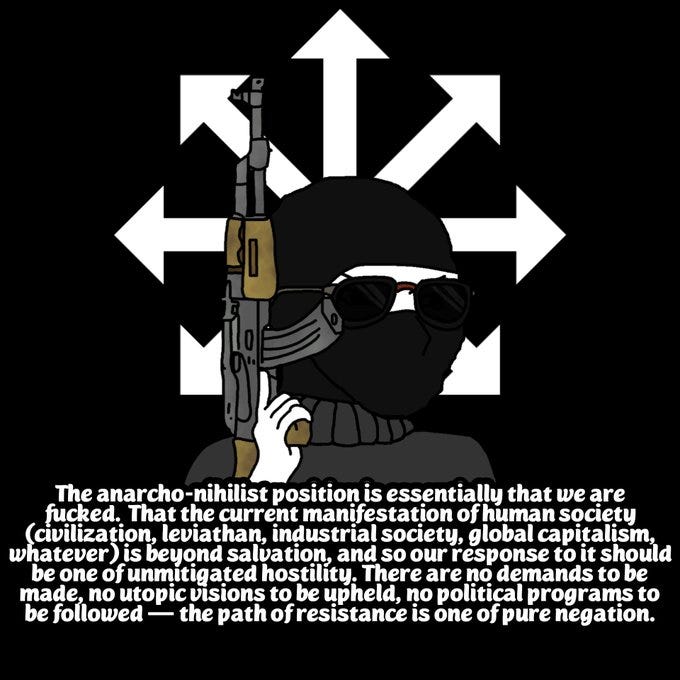
I’ve been spending a lot of time in the past couple of weeks thinking about nihilism in regard to our political situation. While I wouldn’t identify with nihilism myself, I have a healthy suspicion of anyone with a real investment in hope, because most of the time they are trying to sell me something. In some ways, that puts me often in the camp of the nihilists as opposed to the hopefuls. What people are selling does’t matter, I remain skeptical. It could be a socialist mayor, crypto-currency, AI powered utopia, reparations from white people, some kind of communist revolution or even nihilist despair. To be clear, the nihilism I came up around was a politically self described anarcho-nihilism, their anarchist texts were things like Desert, Blessed is the Flame or Letters of Insurgents. A good thing about anarcho-nihilism was that it remained rooted in a set of shared political principles even with the recognition or certainty that “anarchy” might not come to pass. While I don’t really share those beliefs, hanging around some nihilists taught me an important lesson about thinking and examining through everything in the world critically. As opposed to a nihilist, I remain a healthy skeptic trodding through the strange promises of the world.
I think my favorite literary protagonists are skeptics. I think of the narrator in Invisible Man or Holden Caufield in The Catcher in the Rye. A more recent example would be Edie in the novel Luster. Another example would be Bartimaeus from Jonathan Stroud’s Bartimaeus Sequence. Bartimaeus in some ways is the ultimate skeptic. He’s a thousand year old Djinn who has served numerous cruel magician masters over the course of history. In the world that Bart inhabits, magicians rule over the non-magical people (aka commoners in the books) through enslaving Djinn and other magical spirits from the Other Place, a magical realm. However, in the last book, Ptomley’s Gate, Bartimaeus reveals his knowledge of this history where magical empires rise and fall, and why he’s so skeptical of human goodness. I get where he’s coming from. His acerbic wit and observations animate the novels in beautiful ways.
I like to think of my role in the world as a flaneur. A flaneur is a stroller or loafer who observes modern urban life. I wanted to write a bit about how I’ve observed the digital world pushing certain kind of moralistic scripts upon the young Left, even in their own sincerity. I remain skeptical about it all. I was describing my unpublished manuscript to some friends. It follows a flaneur who floats through a city meeting radicals, musicians, and other strange characters. When I wrote it, I was grappling with my experiences around political people that I often found corny, even if I have a deep love for the social movements I emerged from. A part of that love is a skepticism that seems absent from the hope-pilled leftists on this website. Skepticism also just makes for better novels in my view.
I don’t talk about political organization or strategy on this Substack, but I do talk about political affect. The way that we feel about the historic times that we reside in is far more interesting for me than political discussions about what ideology we should follow. I think that a lot of the political affect I’ve observed from the Left in the moment is a sense of hopelessness. I’ve written a bit about this my essay The Melancholy of the Age. The fascinating part is that some of that melancholy’s accompanying political inaction has receded to varying kinds of action. Despite the political actions, the melancholy remains. I think of Rayne Fisher-Quann’s essay

Centrist Imaginations that discusses her involvement in anti-ICE activism. Her exploration of anti-ICE activism was far more interesting to me than critiques of the centrist right, as she attempts to grapple with contradictions on her team. She describes attending an anti-ICE protest.
“My friends and I rolled our eyes at the flippant signs and the handful of people taking pictures, and we cried afterwards at how little we had accomplished, how powerless we felt. It didn’t feel like the revolution. But it wasn’t a party or a game or a Disney ride, either. The people around us were mostly angry and sad, marching slowly in the freezing cold, some holding photos of dead people and missing children. That’s what got me, really: I’d see a few dumb posters and teeter on the edge of feeling superior to the whole thing, and then I’d see another photo of a dead person clutched in a pair of mittens.”
The fascinating part about this essay is Fisher-Quann’s admission of sadness about powerlessness from the protest. While she contrasts it with The Free Press’ claim that anti-ICE activism is some kind of fantasy, it’s clear that Fisher-Quann is describing a political affect rooted in shared sense of hopelessness, and perhaps even shame when it comes to “how little we had accomplished.” She waffles between feeling superior to an ultimately empty protest, but then is reminded of the dead. I understand it as my favorite part of her essay as it adequately describes an affect that not just Fisher-Quann and her friends are feeling, but leans into that affect rather than offering an answer of hope. I wanted more of the writing about the complicated feelings of going to a march and being like “this sucks and isn’t helping nobody.” I want less of the defense of Instagram “de-arrest” infographics, especially as a person who trains martial arts and has been arrested.
I’ve harped on at length about my annoyance with left-wing political commentators because for all of their bluster for their team, most of the writing often drips with a sense of despair. Even though the Left is often derided by the Right and themselves as constantly critical of one another, the reality is that amongst much of the left-wing writing on Substack there is a shared orthodoxy of hope. This hope is often thrust onto abstractions. Left wing Substackers make broad exhortations about “community” or “white people should do something,” while making references to political conditions that have long since elapsed. Well, except Reconstruction, but none of ya’ll want to read DuBois. There is a refusal to deal with the present beyond appeals to the necessity of “doing something” and bearing witness. This brings me to Fisher-Quann’s closing paragraph.
Sometimes you watch someone die on your phone and you can’t do anything for two days but shake and cry. You go to the protests. You send the money. You join the Signal group. It’s not perfect, this stuff, but it’s real. Everyone knows it. You can feel it vibrating in the air, the feeling that no one knows what to do with their pain and fear and anger, their ache to live in a different sort of world than this one — everyone is pawing desperately in the dark for some better way forward, some way to help each other through. We struggle through this failure of catharsis together. We try to figure out what we’ll do next. That’s real life; that’s politics.
Again, I don’t want to give off the vibe that I’m hating on Fisher-Quann as I did like this essay, but her action items feel like they were directly ripped from an Instagram infographic on “how to be an ally” or something along those lines. Unfortunately, in this section, she strays away from the earlier doubts with a determined belief in a collective “we” figuring it out politically. Even much of the way she translates her critique of the Free Press remains rooted in an Internet centric trend oriented way to think about the present moment. Her reference points are Didion and books by Free Press journalist written about the Left, rather than things from the Left itself. It is clearly mediated through Instagram discourses rather a longer appraisal of American history. Her admission that these methods aren’t perfect but they are real is where I take issue with the essay. Fisher-Quann believes that these actions have to mean something even if they are completely meaningless. Her hopeful conclusion is a common one I see amongst left-wing commentators. They are unwilling to be skeptics even of their own actions or even movements. Even the collective wes are strange to me as social movements are always composed of people with differing visions of the world who are often “pawing desperately in the dark” for completely different things. It is not to say that Fisher-Quann is an opportunist, I understand her to be sincere, but I think her claim that leftist politics at least the ones she espouses exist in any more real fashion than The Free Press is a bit of a stretch.
In regard to these differences and as an example, much of my annoyance with claims about nihilism has come from Black Substackers writing notes that are telling white people they aren’t allowed to be nihilistic or something. Obviously, some white people are going to eat this up as they wish to be degraded due to their own strange psycho-sexual relationships to Black people. A similar but different psycho-sexual feeling animates the Black influencers who seem to have a fixation upon telling white people to behave. That’s a whole other essay that I will never write cause ya’ll will cancel me. But the claim that nihilism or hopelessness is a white attribute is a bit silly. While I won’t get into Black nihilism or Afro-pessimism as philosophies, throughout the African-American musical and literary tradition, there are deep wells of despair that often result in death. I think of Leadbelly’s song Goodnight Irene where he sings about his desire to jump into a river and drown. The vision that Black struggle is one thing is corny. Like everything, there’s a multitude of expressions. The belief that despair and nihilistic feelings are purely the product of whiteness is boring. It’s also a strategy of Black race whisperers who seek to sell white people something. Hope by way of sending money to those Black influencer’s CashApps. And shit, I can’t knock the hustle. But don’t pretend that being mad at white people on the Internet is politics. They’ll keep being white even if they send you money. In some ways, Fisher-Quann’s rightful rebuke of the Free Press is just another version of this kind of leftist scolding, which remains uninteresting to me. I just don’t care about the opinions of folks like Bari Weiss to even dignify them with a response. But maybe that’s just cause I live in Philadelphia.
My Substack doesn’t claim to have political answers or offer any type of strategy other than getting off that DAMN phone. I’m also not arguing for any kind of political inaction, either. Go to the protest if you feel inspired, but if you don’t feel inspired, why are you going? Is it just another social script? I am just merely seeking to describe a phenomenon. Fisher-Quann and her peers differ from the anarcho-nihilist activists of my youth. The nihilists in my youth had zero faith that any of their actions would lead to “something better,” and then often lost the moralism. They still acted in ways that I found to be dignified, independent of a desire for “community” or a “future.” I don’t know if it’s a necessarily useful posture to be nihilistic. But I do think that what I learned from them was the importance of being skeptical if someone is trying to sell you something, even if the product they are selling you is hope.
Nihilism, at the very least, seems like a form of de-conditioning and unlearning, of presence. Throwing a narrative of hope and community after an acknowledgment of something deeply broken... it feels more stagnant somehow, like trying to turn everything into a narrative of triumph and heroism, without fully understanding or listening to the moment. I think it's worth questioning that impulse, which feels really embedded into the American psyche. Enjoyed this piece! (Was ready to dislike it, I must say, because nihilism and violence seem so tied in my brain, but I was nicely surprised!)
this made me think. i 100% agree with you in a lot of ways, although I am not sure i have the same response
also, dude, we gotta be the same age. redwall, bartimaeus, next youll be saying pendragon. love it