
Modern Problems
A literary experiment in relation to left-wing infighting, the avant-garde, atomization, deindustrialization, and the shoplifting discourse

Note: Hilde von Bingen suggested I write something about organizing in warehouses and unions. I’m not someone who does prescription or political theorizing publicly, but I hope this literary experiment helps to illuminate the tough conditions that the American Left finds itself in as it relates to the current discourse. It was also a fun exercise intellectually. This piece was inspired by surrealism, trolling socialist PhDs on Substack and the Metropolitan Review essay by Thomas Peermohamed Lambert on Sam Kriss. Happy belated May Day! Power to the workers, I think?
A Question:
How do you create a literary avant-garde in an era of increased atomization?
An Answer:
Well, what an interesting query. Let’s begin by examining why atomization has occurred and it’s political ramifications in a country that is not exactly the same as, but also not unlike the United States.
The place I imagine is multi-cultural and huge, a powerhouse of industry, a land of ideals, even if the land was taken by force. Either way, it was the center of the world when it came to making things. There were many factories creating notebooks, iron, jeans, paint, waffles, washing machines, towels, concrete, soap, oil based products and DVDs. And the people there used to work in these factories. But not anymore. Unemployment and underemployed stretched across the country. It killed towns first and then the cities. People bought less and started putting needles into their arms to distract themselves from their wretched lives. As the factories disappeared, on the South coast, radio-phones were developed in what was to be called the Electric Delta. The radio-phone industry was supposed to save everyone, but it mostly just resulted in the radio-phone company shareholders getting rich while everyone else worked for a pittance. The radio-phone transmissions made everyone unhappy, but also helped the numb the ache of their lost jobs as well as numbing the ache of existence itself so they weren’t all bad.
Some of the people weren’t allowed to work in factories for most of the country’s history because they were deemed to not be a part of the dominant classes due to their status as members of an ethnic/racial minority. They were considered the “last hired, first fired” as some would say. As the robots began to automate production, more and more of the jobs disappeared for everyone, but most prominently for the racial and ethnic minorities. The gradual shifts in the economy confounded the communists who venerated a figure named Henry Cantor, a renowned writer and economic theorist. He would be considered similar to a mix of DuBois and Marx in an American context. Anyway, the Cantorists found themselves beset by the contradiction, how were they to organize in the factories if the factories themselves were disappearing to other countries where the corporations could pay people less?
Some of Cantorists decided to elect socialists into office in order to expand the rapidly deteriorating welfare state. They also prayed that unions would magically appear. They did not. Meanwhile other Cantorists found themselves stuck in prison due to their transformation from proletarian ethnic/racial minority subjects into members of the growing surplus populations beset by an ever expanding police state. The chief of the Federal police had promised to “wipe out” the ethnic/racial minority factions of Cantorists, so it was all quite tense for a while. But it was all dreadfully dull also, to be clear. Cantor had written that economic changes marked a break in the existing order and lead to crisis, but instead of crisis, everyone just complained, cried, zoned out or raged on their radio-phones. Many of the Cantorists were okay economically, as they came from the middle classes (whatever the hell that means) so their jobs were not impacted to the same degree. Basically, many of the Cantorists did not and had never worked in the factories. This didn’t stop them from desiring a social change or even a social revolution. For example, another faction of the Cantorists broke from the communist tradition and found anarchy. They became bored of sitting in the Cantorist meetings where the socialists would pontificate endlessly about the importance of unionizing the radio-phone distribution centers while never actually organizing those places themselves. Predictably, the radio-phone distribution centers had high turnover rates and terrible conditions, not to mention the fact that most Cantorists were unwilling to leave their jobs in public service, universities, and publishing to organize the proletarian mass. Instead of listening to the socialists, the anarchist faction nicknamed “the commotionists” joined the spontaneous rebellions of the surplus populations against the rising power of the police and the prisons. The commotionists also shoplifted from the grocery stories owned by the radio-phone companies, which lead to a public denunciation in Modern Problems, the most important Cantorist journal. These divisions about what to do with the old economy lead to the different Cantorist factions spending time writing long polemics accusing one another of being revisionist, adventurist, counter-revolutionary, and other such things. As you can imagine, between the radio-phones, the increased levels of repression and unemployment, many of the Cantorists took to writing novels to relieve themselves of the boredom, fear, and ache of modern life.
These novels were often quite boring and took on a form called self-concoction that you and I would consider to be similar to what some call “auto-fiction” today but with a Cantorist political-economic analysis in most cases. The editor of Modern Problems, Julia Winfrey, a professor at one of the most prestigious universities in the country, wrote a long treatise calling the self-concoctionists petty bourgeois liberals who were too enamored with their own artistic ambitions. The self-concoctionists were tied up socially with some of the commotionists I mentioned earlier, as everyone was fucking each other just how everyone fucks now. Sometime I wonder if all politics is just secretly a way for people to fuck. But the commotionists were often not erudite enough for the self-concoctionists, despite their shared attraction. The anarchists maintained strict programs of abstinence, armed training and eight hour consensus processes. They found art to be a “bourgeois frivolity” most of the time. Despite this, the self-concoctionists found themselves often next to the commotionists when the surplus populations rioted as striking no longer made any sense. At the revolts, the self-concoctionists would find themselves reciting poetry, playing the grammo-zam (an instrument that crosses a saxophone and a dictionary), yelling incantations at the police, taking footage for their narrative short films, and overall just being a nuisance. Meanwhile the angry anarchists and even angrier sections of the surplus populations threw rocks, lit trash on fire and looted the convenience stores. Julia Winfrey wrote another article in Modern Problems about how riots lead to “low social trust” and why the self-concoctionists were engaging in idealist romanticization of the “criminal underclass” through their participation. Either way, the self-concoctionists were eventually forced out of the commotionists political meetings for always suggesting a series of writing workshops, instead of learning how to throw elbows at the fascists. Oh, I should mention the fascists.
Well, as people lost jobs in the factories, some of the previously employed from the dominant ethnic and racial groups got mad. They got very mad. And they blamed their job loss on the racial and ethnic minorities. It was an unfortunate situation, but that was what was happening. One of them was this guy named Harold Hopper. Harold Hopper and his family had always worked in the auto-plants, but then the auto-plants disappeared. Unfortunately, Harold Hopper’s mortgage didn’t. He ended up having to work as a delivery driver for one of the radio-phone companies. The pay was much lower so he didn’t get to see his kids as much and his wife left him. Harold was not reading Modern Problems as the journal mostly circulated in the universities and on the socialist forums online. Harold liked to listen to his radio-phone between shifts. On his device, he’d learn about how the ethnic and racial minorities were supplanting workers like him. He grew to resent their food, their music, and their style of dress. He worried that his daughters might date an ethnic or racial minority one day. The complicated part was that some ethnic and racial minorities were doing better than Harold Hopper. Not all of them as many were in prison, but a racial and ethnic minority middle class did exist. Obviously, not all racial and ethnic minorities occupy the same position in society, but I think you catch my drift. Either way, Harold Hopper eventually joined one of those fascist groups that promised to bring things back to the way things were. Harold would go out and shout at women from the racial/ethnic minorities on the bus stop for wearing their traditional clothing. He never did anything to the men as he was scared that they would stab him as he viewed all ethnic/racial minority men to be fabulously good at violence as they were all in prison or headed there in his mind. Harold claimed he didn’t hate the racial/ethnic minorities, he just wanted them to assimilate.
There were many debates in Modern Problems about how to reach people like Harold. The commotionists were less interested in reaching people, they wanted to punch people like him in the face, which is why they were training martial arts. This confounded the self-concoctionists who really didn’t like to exercise most of the time. They ended up founding their own journal in the back of the commotionist print shop. The anarchists allowed it because one of the self-concoctionists was secretly bourgeois and helped pay the rent. The self-concoction journal was called Modern Dreams, as they were slowly moving away from a vision of self-concoctionism as something that was thoroughly rooted in material reality. Their new self-concoctionism was rooted in a subconscious understanding of reality. To the Cantorist clique at Modern Problems, this was even more problematic as it strayed even further from addressing questions of how to organize people like Harold Hopper or other members of the vanishing proletariat.
So to answer your question, I have no idea how to create an avant-garde movement other than probably writing and reading a lot like the self-concoctionists. Perhaps you might also recite poetry in the midst of an explosive social revolt. But who am I to say?
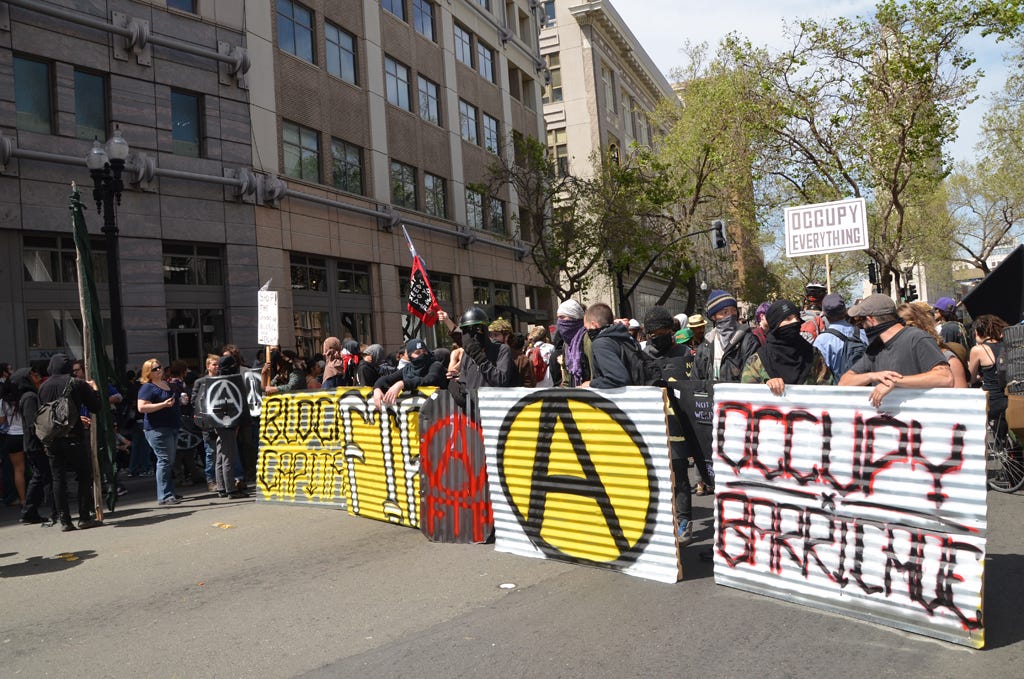
Occupy Oakland General Strike on May Day, 2012
“ Harold was not reading Modern Problems as the journal mostly circulated in the universities and on the socialist forums online. Harold liked to listen to his radio-phone between shifts.” Understated bars
this was really good